
Follow the surviving trail
- 1927 · The ledger opens with Bell at 1–1
The original score PDF lists a Bell win and loss without scores. The October 1 newspaper account identifies and scores the loss, 13–6; the separate win is retained as a ledger-only entry.
- October 8, 1927 · At Sumner High in Portland
The Banner records a 68–0 loss. School-history evidence connects the historical Sumner High name with Portland’s program.
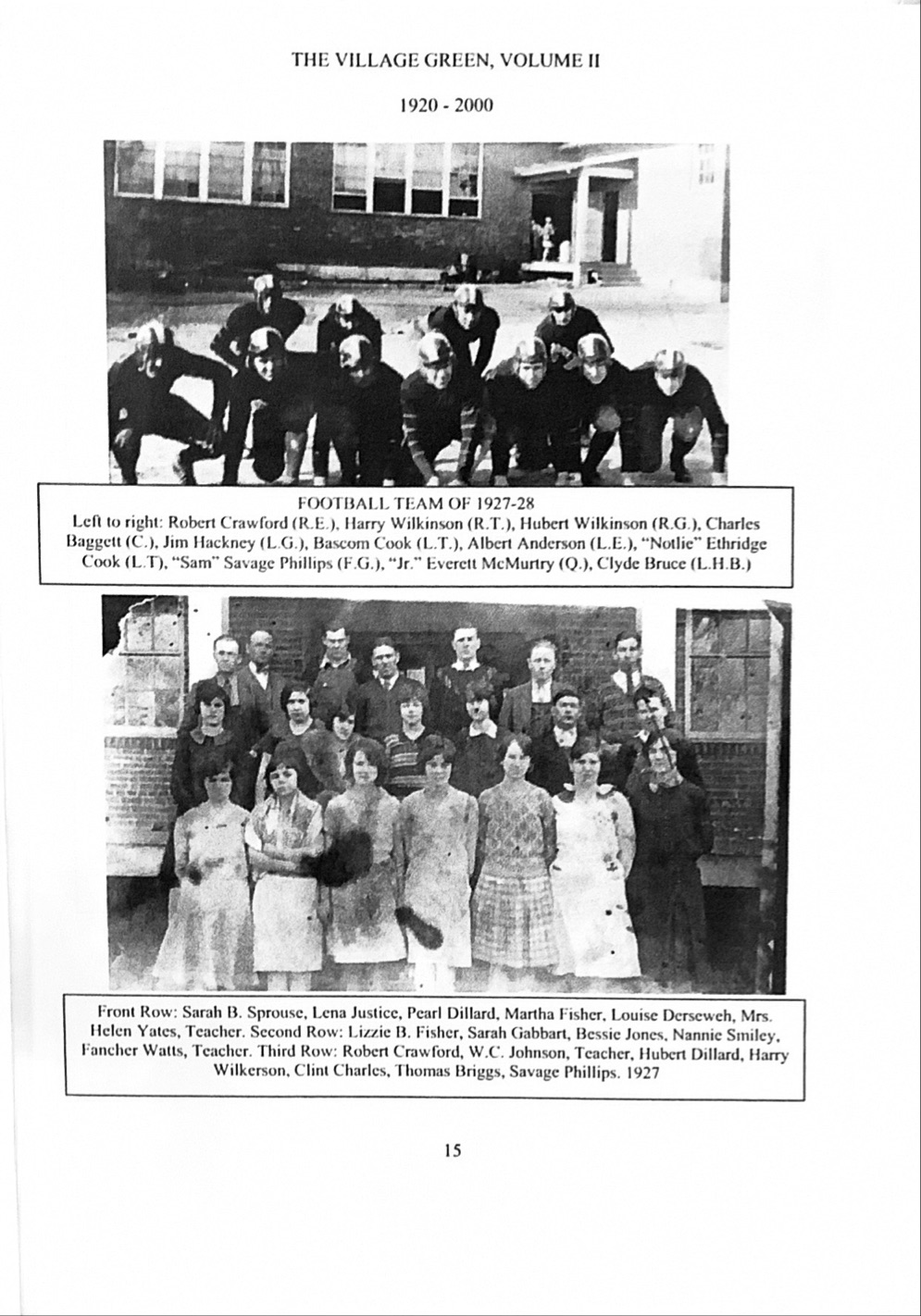
- 1927–28 · Eleven players in one caption
The Village Green names Robert Crawford, Jim Hackney, Everett McMurtry, Clyde Bruce, Savage Phillips and six teammates with positions.
- October–November 1928 · Five newspaper results
Duncan, Goodlettsville, Jere Baxter and Bell beat Greenbrier; Greenbrier defeats Jere Baxter 39–12. The November lineup now has enough school-roster continuity to be classified with Greenbrier High.
- 1928 · The master ledger restores a second Bell result
The source PDF again prints Bell W and Bell L under a 1–1 heading. The scoreless win becomes the sixth combined archive entry.
- 1929 · A win, a tie and an open result
Portland is a 26–16 win, Ashland City a 0–0 tie, and Bell remains an entry with no recovered outcome.
Jere Baxter: why the November win now counts
The October 26 game is explicitly Greenbrier High: a 6–0 loss at Jere Baxter. The November 8 report prints a 39–12 Greenbrier win but uses “amateur.” Earlier work left it outside the school series because that single article did not explicitly name Greenbrier High.
The new source chain changes the balance. Robert Crawford is a right end in the 1927–28 school-team photograph, the October school lineup and the November lineup. McMurtry, Hackney, Bruce and other surnames connect the photograph and the two fall lineups. The October and November reports also share Crawford, Shannon, Dillard, Hackney, Crutcher, Dorris and McMurty/McMurtry.
Compare the evidence table · Read the scoring account · Open the 1–1 series.
Why Bell had nine meetings in one place and seven in another
The all-opponent table retained nine Bell entries and a 4–4 record with one unknown. The detailed Bell page showed entries and a 2–4 record because the scoreless Bell wins printed under 1927 and 1928 had not been rebuilt as game pages.
Those two wins are now restored. The reconciled series is nine meetings: four wins, four losses and one unknown result. Known-score points are 50–37 because only entries have recoverable scores. The main table and series page now use the same combined-source rules.
Four rules for the first decade
Blank is not “no team”
A year with no ledger entries stays an open file. Only an explicit no-team source supports a no-team label.
Result is not score
A W or L can count when the source supplies it. Unknown points remain excluded from PF and PA.
Archive order is not a date
Restored ledger entries receive catalog numbers, but the site does not place them chronologically without a dated source.
Inference must show its work
The November 1928 classification is published with the photograph and lineup chain that supports it.
From fragments to a perfect season
The 1930–37 pages now distinguish blank years, score-only games, an outcome without a score and the 1935–36 team photograph. Together they lead into the 6–0 season of 1938.