
What survives—and what does not
The ledger records a 26–16 Portland win, a 0–0 Ashland City tie and a Bell entry with no result.
No football entry survives. Carter’s basketball success gives school context, not football scores.
Cedar Hill 12–0 and Adams 6–0: two listed wins, two shutouts.
Bell wins 12–0 in the single recovered entry.
A headed blank. No result and no no-team claim.
A Bell loss survives, but its score cannot be calculated.
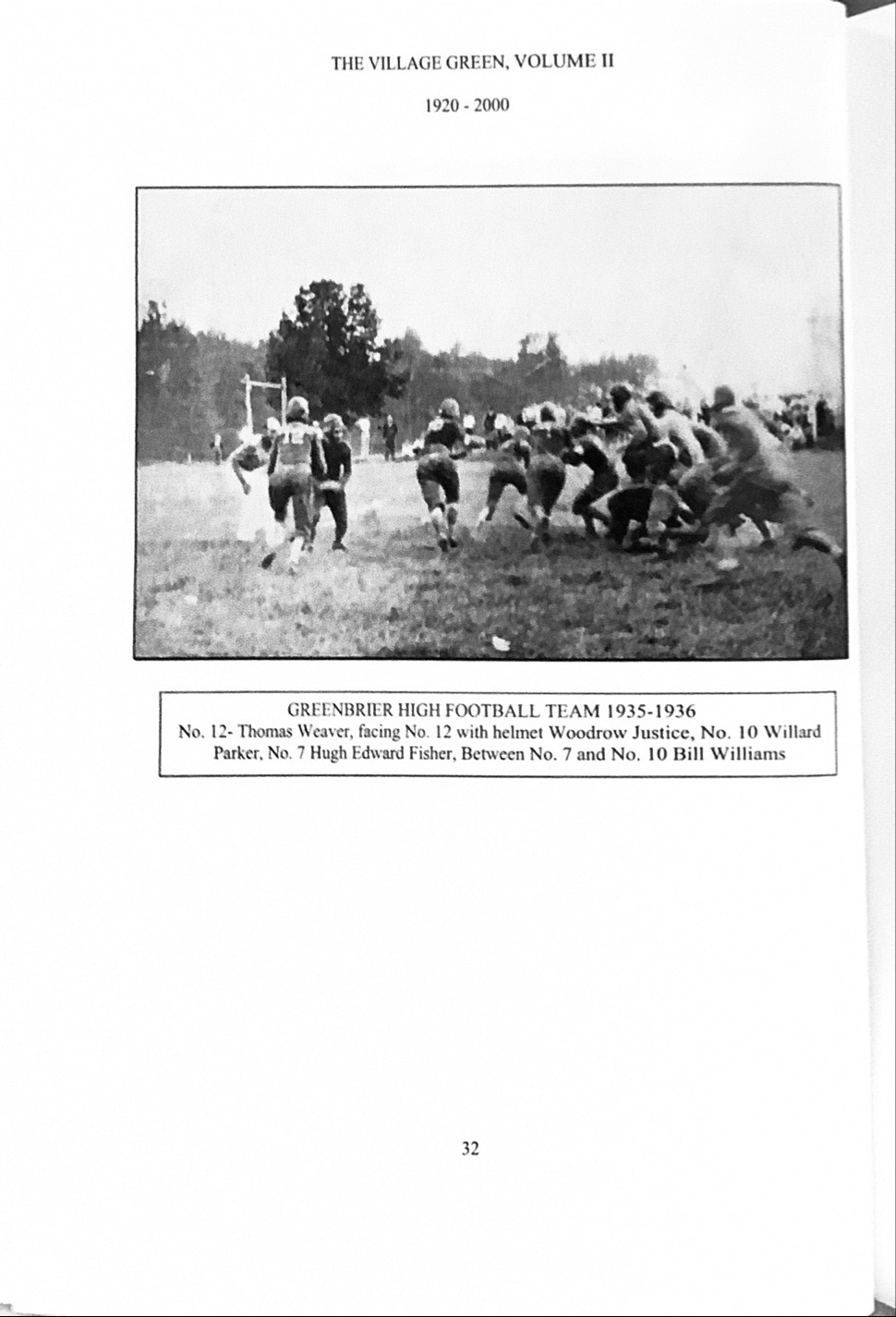
A 35–0 Lipscomb loss is filed under 1935; a school-year action photograph names five players.
Greenbrier beats Cedar Hill 13–6 and loses to Clarksville 12–6.
Six wins, four shutouts, 228 points scored and 20 allowed.
First full-time does not mean first ever
The Greenbrier Athletic Hall of Fame describes Joe Henry Carter as Greenbrier High’s first full-time coach of an eleven-man football team and says he arrived after one year at Coopertown. The Village Green, drawing on the student newspaper The Voice, calls him the school’s first regular coach, while also preserving Wilburn Shannon’s memory of A. G. Capps and a Mr. Smith before Carter.
Those accounts fit together when the qualifiers stay attached: Carter represents the transition to a regular, full-time coaching role; the record does not erase earlier coaches. The football coaching ledger carries Carter through this 1930s span. His Hall profile also preserves the practical reality that some players had to be firmly persuaded to wear helmets.
Basketball helps show the breadth of his role without becoming football evidence. Carter coached the 24–3 team that traveled to the 1930 state tournament, the 18–2 team of 1930–31 and Greenbrier boys basketball through 1943 except 1933–34. He entered insurance work in 1943 and was inducted into the local Hall in 2005.
Greenbrier Athletic Hall of Fame profile ↗ · Carter’s connected VOTC file · Train to Knoxville.
1937 fragment vs. 1938 perfect file
19–18 scoring · 9.5 points per listed game · two one-score finals.
228–20 scoring · 38.0 points per game · four shutouts · +208 margin.
The comparison is descriptive, not causal. Because the file may be incomplete, it cannot support claims about a full-season statistical leap. It can show exactly how the two surviving records differ.
The margin swings 48 points between the two preserved meetings. No date or site is available for either entry in the master score list.
Four kinds of evidence, four jobs
All-time score PDF
Season headings, opponents, final scores and W/L/T markers. It does not provide early dates or sites.
Contemporary newspapers
Dated reports, lineups, scoring and game detail for 1927–28. They can add games absent from the later ledger.
The Village Green
Photographs, full names, school context and memories. Page captions are transcribed without expanding them into unlisted facts.
Hall of Fame
Biographical context, induction history and Carter’s full-time coaching description. Scores continue to follow the score-source hierarchy.
Open the score ledger · Open the newspaper reconciliation · Enter the 1938 season.